VAWA Self-Petition Statistics 2026: Approvals, Denials and a 272,911-Case Backlog
Sixteen years of USCIS data on Form I-360 self-petitions under the Violence Against Women Act: who files, how decisions have moved, and why the queue keeps growing.
- Published
- Updated
- Compiled by
- Ace Immigration, the law firm of attorney Anna Tsibel
- License
- CC BY 4.0 — free to republish with credit
Data: USCIS Form I-360 VAWA report, FY2026 Q3 (through June 30, 2026); USCIS all-forms quarterly reports through June 30, 2026. Files retrieved October 31, 2026.
Key figures
272,911
VAWA self-petitions pending at USCIS on June 30, 2026, 52 times the 5,285 pending in FY2010
U.S. Citizenship and Immigration Services, July 202668.1%
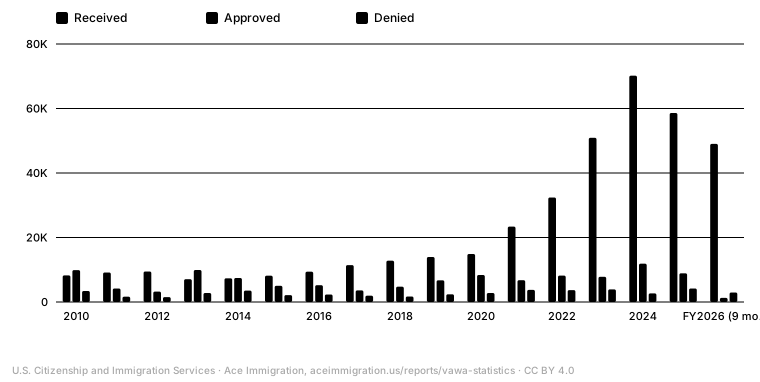
of FY2025 decisions were approvals (8,914 approved, 4,177 denied); in the first nine months of FY2026 the share fell to 30.1%
U.S. Citizenship and Immigration Services, July 202670,172
self-petitions filed in FY2024, the record year; 32,868 of them by abused parents of adult U.S. citizens
U.S. Citizenship and Immigration Services, July 20266.4 months
USCIS median processing time for all Form I-360 categories completed in April to June 2026; the VAWA queue implies far longer waits for most
U.S. Citizenship and Immigration Services
Filings rose sevenfold; decisions did not keep up
USCIS received 70,172 VAWA self-petitions in FY2024, +751% more than in FY2010, and 58,592 in FY2025. Approvals never exceeded 11,866 in a year; in FY2025 USCIS approved 8,914 petitions and denied 4,177, and in the first nine months of FY2026 it approved 1,267 and denied 2,944 while receiving 49,012 (USCIS).
Source: USCIS: Form I-360, Petition for Amerasian, Widow(er), or Special Immigrant (VAWA), FY2026 Q3, data generated July 2026All three self-petitioner categories combined (abused spouses, children and parents). Approval share = approved ÷ (approved + denied).
Show the data
| Fiscal year | Received | Approved | Denied | Approval share | Pending at year end |
|---|---|---|---|---|---|
| 2010 | 8,248 | 9,885 | 3,418 | 74.3% | 5,285 |
| 2011 | 9,150 | 4,177 | 1,642 | 71.8% | 8,791 |
| 2012 | 9,461 | 3,222 | 1,532 | 67.8% | 13,526 |
| 2013 | 7,080 | 9,931 | 2,806 | 78.0% | 7,532 |
| 2014 | 7,359 | 7,446 | 3,530 | 67.8% | 3,913 |
| 2015 | 8,165 | 5,014 | 2,146 | 70.0% | 4,957 |
| 2016 | 9,394 | 5,194 | 2,325 | 69.1% | 6,976 |
| 2017 | 11,445 | 3,585 | 1,960 | 64.7% | 12,945 |
| 2018 | 12,804 | 4,753 | 1,710 | 73.5% | 19,148 |
| 2019 | 13,944 | 6,731 | 2,387 | 73.8% | 24,458 |
| 2020 | 14,877 | 8,377 | 2,803 | 74.9% | 29,188 |
| 2021 | 23,391 | 6,766 | 3,755 | 64.3% | 42,562 |
| 2022 | 32,413 | 8,187 | 3,695 | 68.9% | 63,635 |
| 2023 | 50,907 | 7,817 | 3,898 | 66.7% | 104,094 |
| 2024 | 70,172 | 11,866 | 2,680 | 81.6% | 160,229 |
| 2025 | 58,592 | 8,914 | 4,177 | 68.1% | 194,452 |
| FY2026 (to June 30) | 49,012 | 1,267 | 2,944 | 30.1% | 272,911 |
The queue: 272,911 petitions and growing every quarter
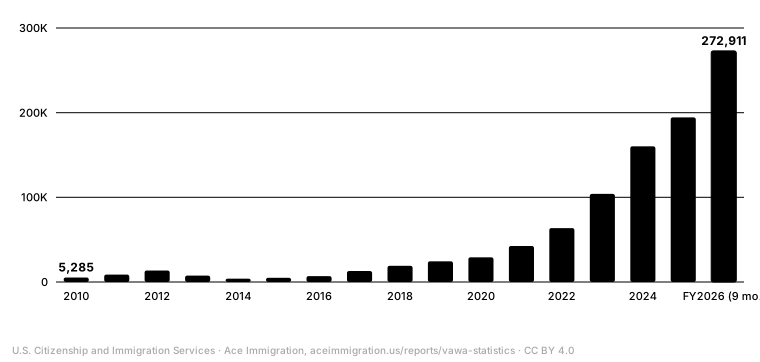
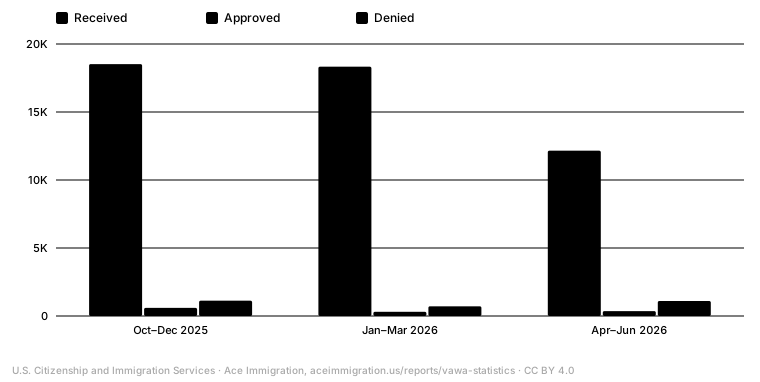
The pending VAWA queue stood at 272,911 on June 30, 2026, up from 194,452 nine months earlier and 29,188 at the end of FY2020. Spouses account for 143,527 of the pending petitions and parents for 124,527. At FY2025's pace of 13,091 decisions a year, clearing the queue would take about 21 years even with no new filings (USCIS).
Source: USCIS: Form I-360, Petition for Amerasian, Widow(er), or Special Immigrant (VAWA), FY2026 Q3, data generated July 2026The parent category was first reported in FY2017; blank cells are values USCIS withholds for privacy.
Show the data
| Fiscal year | Spouses | Children | Parents | All pending |
|---|---|---|---|---|
| 2010 | 5,017 | 268 | — | 5,285 |
| 2011 | 8,322 | 469 | — | 8,791 |
| 2012 | 12,847 | 679 | — | 13,526 |
| 2013 | 7,182 | 350 | — | 7,532 |
| 2014 | 3,776 | 137 | — | 3,913 |
| 2015 | 4,756 | 201 | — | 4,957 |
| 2016 | 6,680 | — | — | 6,976 |
| 2017 | 12,150 | 439 | 356 | 12,945 |
| 2018 | 17,215 | 765 | 1,168 | 19,148 |
| 2019 | 21,358 | 920 | 2,180 | 24,458 |
| 2020 | 24,883 | 896 | 3,409 | 29,188 |
| 2021 | 34,543 | 1,105 | 6,914 | 42,562 |
| 2022 | 47,230 | 1,593 | 14,812 | 63,635 |
| 2023 | 67,872 | 2,615 | 33,607 | 104,094 |
| 2024 | 92,619 | 3,704 | 63,906 | 160,229 |
| 2025 | 107,132 | 4,029 | 83,291 | 194,452 |
| FY2026 (June 30) | 143,527 | 4,857 | 124,527 | 272,911 |
- USCIS reports a median of 6.4 months for all I-360 categories completed in April to June 2026, with 311,184 I-360 petitions of every kind pending (USCIS). VAWA cases make up 88% of that queue.
Approval share: 82% in FY2024, 30% in FY2026 so far
Across FY2010 to FY2025 USCIS approved 111,865 VAWA self-petitions and denied 44,464, an approval share of 71.6%. The share reached 81.6% in FY2024 and fell to 68.1% in FY2025. In the first nine months of FY2026 denials (2,944) outnumbered approvals (1,267) for the first time in the series, a share of 30.1% (USCIS).
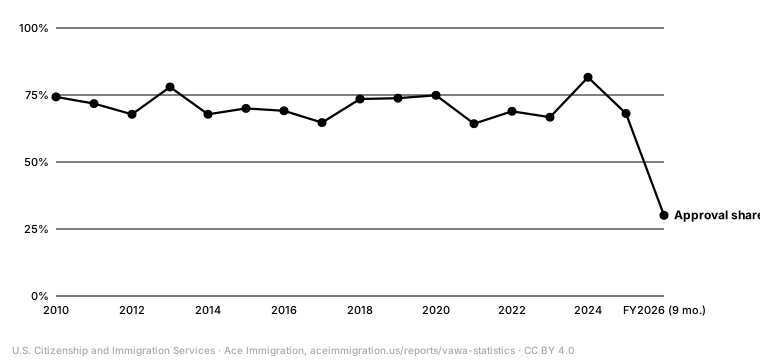
Source: USCIS: Form I-360, Petition for Amerasian, Widow(er), or Special Immigrant (VAWA), FY2026 Q3, data generated July 2026
Show the data
| Quarter | Received | Approved | Denied | Pending |
|---|---|---|---|---|
| Oct–Dec 2025 | 18,523 | 597 | 1,127 | 212,329 |
| Jan–Mar 2026 | 18,333 | 311 | 716 | 259,529 |
| Apr–Jun 2026 | 12,156 | 359 | 1,101 | 272,911 |
Who files: parents of adult citizens now nearly match spouses
Abused spouses filed 35,917 petitions in FY2024 and 29,044 in FY2025. The fastest-growing group is abused parents of adult U.S. citizen sons and daughters: 498 petitions in FY2017, the first year reported, 32,868 in FY2024 and 28,335 in FY2025. Parent petitions were approved far less often: 1,373 approvals against 920 denials in FY2025, compared with 7,388 against 2,684 for spouses (USCIS).
Source: USCIS: Form I-360, Petition for Amerasian, Widow(er), or Special Immigrant (VAWA), FY2026 Q3, data generated July 2026
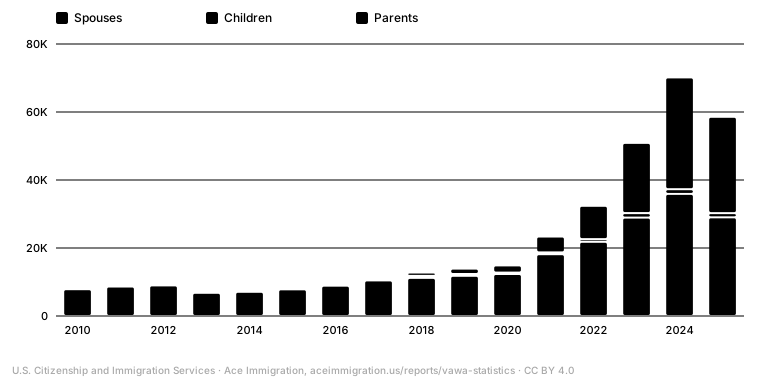
Show the data
| Fiscal year | Spouses | Children | Parents | Total |
|---|---|---|---|---|
| 2010 | 7,868 | 380 | — | 8,248 |
| 2011 | 8,667 | 483 | — | 9,150 |
| 2012 | 9,006 | 455 | — | 9,461 |
| 2013 | 6,815 | 265 | — | 7,080 |
| 2014 | 7,130 | 229 | — | 7,359 |
| 2015 | 7,865 | 300 | — | 8,165 |
| 2016 | 8,906 | — | — | 9,394 |
| 2017 | 10,485 | 462 | 498 | 11,445 |
| 2018 | 11,216 | 581 | 1,007 | 12,804 |
| 2019 | 11,838 | 525 | 1,581 | 13,944 |
| 2020 | 12,344 | 412 | 2,121 | 14,877 |
| 2021 | 18,172 | 544 | 4,675 | 23,391 |
| 2022 | 21,820 | 804 | 9,789 | 32,413 |
| 2023 | 28,946 | 1,326 | 20,635 | 50,907 |
| 2024 | 35,917 | 1,387 | 32,868 | 70,172 |
| 2025 | 29,044 | 1,213 | 28,335 | 58,592 |
How to read these numbers
- VAWA self-petition
- Form I-360 filed under the Violence Against Women Act by an abused spouse, child or parent of a U.S. citizen or lawful permanent resident, without the abuser's participation. The law applies regardless of gender.
- Pending
- Petitions awaiting a decision at the end of the period. USCIS notes that transfers and administrative closures are not reflected, so pending counts cannot be derived from earlier periods.
- Withheld cells
- USCIS replaces some small counts with D or H to avoid disclosing figures about few people; those cells are blank here and left out of sums.
- Processing time
- USCIS publishes a single median for all Form I-360 categories (VAWA, special immigrants, widows and widowers), so it understates the VAWA wait; no VAWA-specific median is published.
Sources and method
Every figure on this page comes from a file published by the U.S. government, retrieved October 31, 2026. The tables were extracted from the original PDF and Excel files by scripts that check each table against the totals printed in the same file (row sums, recomputed rates, fiscal-year sequences). Derived measures such as approval shares and year-over-year changes are computed from the published counts, and the formula is stated next to each one.
The federal fiscal year starts on October 1: FY2026 runs from October 1, 2025 to September 30, 2026. Partial years are marked. Agencies suppress small cells to protect privacy; those cells are shown as “—” and left out of sums, which explains small gaps against national totals.
- USCIS: Form I-360, Petition for Amerasian, Widow(er), or Special Immigrant (VAWA), FY2026 Q3
U.S. Citizenship and Immigration Services · data generated July 2026 · agency page
- USCIS: All USCIS Application and Petition Form Types, FY2026 Q3
U.S. Citizenship and Immigration Services · agency page
General information, not legal advice. Statistics describe groups of cases, not yours: an outcome depends on the facts, the evidence, the court and the governing law. Publication does not create an attorney-client relationship.
Abused by a U.S. citizen or green card holder in your family?
A VAWA self-petition is filed without the abuser's knowledge and is decided on the evidence in the file. The queue is long, so the file has to be right the first time. Attorney Anna Tsibel prepares confidential self-petitions in English and Russian.
We take these cases: Asylum, Deportation and removal defense, Family and marriage-based immigration, K-1 fiancé(e) visa, I-751 removal of conditions and waivers, Inadmissibility waivers, VAWA self-petitions, Citizenship and naturalization.
(805) 409-9384